Resources
Myofascial Release
Myofascial release is one of the approaches Aaron may incorporate into an Integrative Massage. It is not booked as a separate service; each session is shaped around what your body needs that day.
“Fascia is ’the organ of form’ — a continuous web that ‘wraps, connects, and permeates every structure in the body. Myofascial release is the art of listening to this living fabric, coaxing it back from its patterns of tension and strain, allowing the body to remember its natural ease and fluidity.’”
Tom Myers, author of “Anatomy Trains: Myofascial Meridians for Manual and Movement Therapists”
SHORT VERSION as an ad
What is Fascia?
Fascia is a lattice-shaped network of connective tissue surrounding everything - surrounding every bone, organ, muscle, vein and artery. While muscles provide structural support and the ability for humans to move parts around, fascia provides ’tensegrity’ to our system.
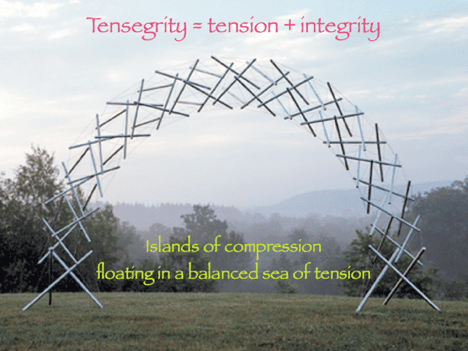 Photo credit: Anatomy Trains: Tensegrity
If we look at a house, it is largely a compression structure. The concrete foundation at the bottom has the most weight on it, because each layer of brick, through the influence of gravity, is adding it’s weight to the layers below it. Each component that is stacked compresses those below it. The easiest example is a brick wall:
 Photo credit: UKPTG
Tensegrity works differently:
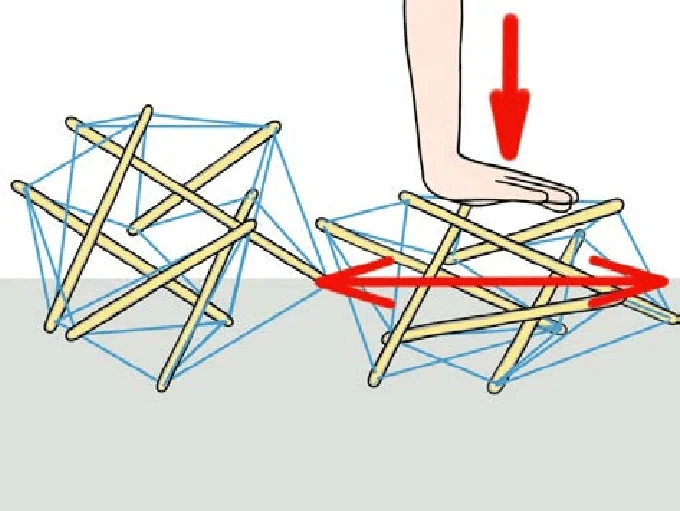
Photo credit: ResearchGate
In a relatively mobile body, the fascial network will act like the tensegrity ball on the left - opposing stability and tension keeping the interstitial space open. And when an outside force is applied (such as compression) as in the right, the fascial system will respond with fluidity and then move back into the position on the left once the compression is removed.
In a less mobile body, the fascial network (or parts of it) start to resemble the ball on the right, even when no outside force is applied. This has all sorts of implications for our health. Some common and more noticeable examples include muscle pain and strain, poor posture, chronic joint compression and the resulting wear and tear (osteoarthritis!), and reduced organ function. There are all sorts of other known and potential mechanisms that reduced fascial function may trigger, but for massage therapy these are some of the issues that are in our scope of practice to assist with.
What is Myofascial Release?
Since fascia surrounds every muscle, bone, organ, etc. in our body, by working with the fascia we can effect change in those structures that fascia is connected to. By loosening the chronic closing and tightening of the fascial network we bring space back in, allowing the fascia and all connecting body parts to function better. And since fascia is a connected network that runs from head to toe, by working on the fascia in one area we are also effecting change in the functioning of the body system as a whole.
Myofascial release typically uses slow, gentle compression with the aim to ‘melt’ the fascia. In my experience, fascia is typically pulled in one or more directions from too much tension in another area of the body, and a skilled practicioner can identify what direction the fascia needs to move in order to release those tensions.
 Photo credit: Dr. Brian Johnson Therapy